
Can we see the One in all—without pretending that all are the same?
17 chapters. One continuous story of Asha Deshmukh and a community learning how the Bhagavad Gita’s vision of oneness changes discrimination, ownership, justice, borders and care for Earth.
The narrated edition and its free sample will appear here after audio production and quality review are complete.
What would change if no life could remain outside your conscience?
We divide quickly: mine and yours, our people and their people, worthy and unworthy, human and nature. Some distinctions help us act wisely. But when a difference becomes the whole person, it hardens into discrimination, exploitation and conflict.
- You want unity without erasing real differences or unequal needs.
- You want to oppose harm without turning another person into an enemy in your heart.
- You wonder whether property can become stewardship rather than absolute ownership.
- You want the Gita’s vision to become a practical way of living—not a slogan.
“The person whose self is joined through yoga and whose vision is equal everywhere sees the Self abiding in all beings and all beings abiding in the Self.” — Bhagavad Gita 6.29 · UniversalVani independent rendering
One school. One family dispute. One river shared by many lives.
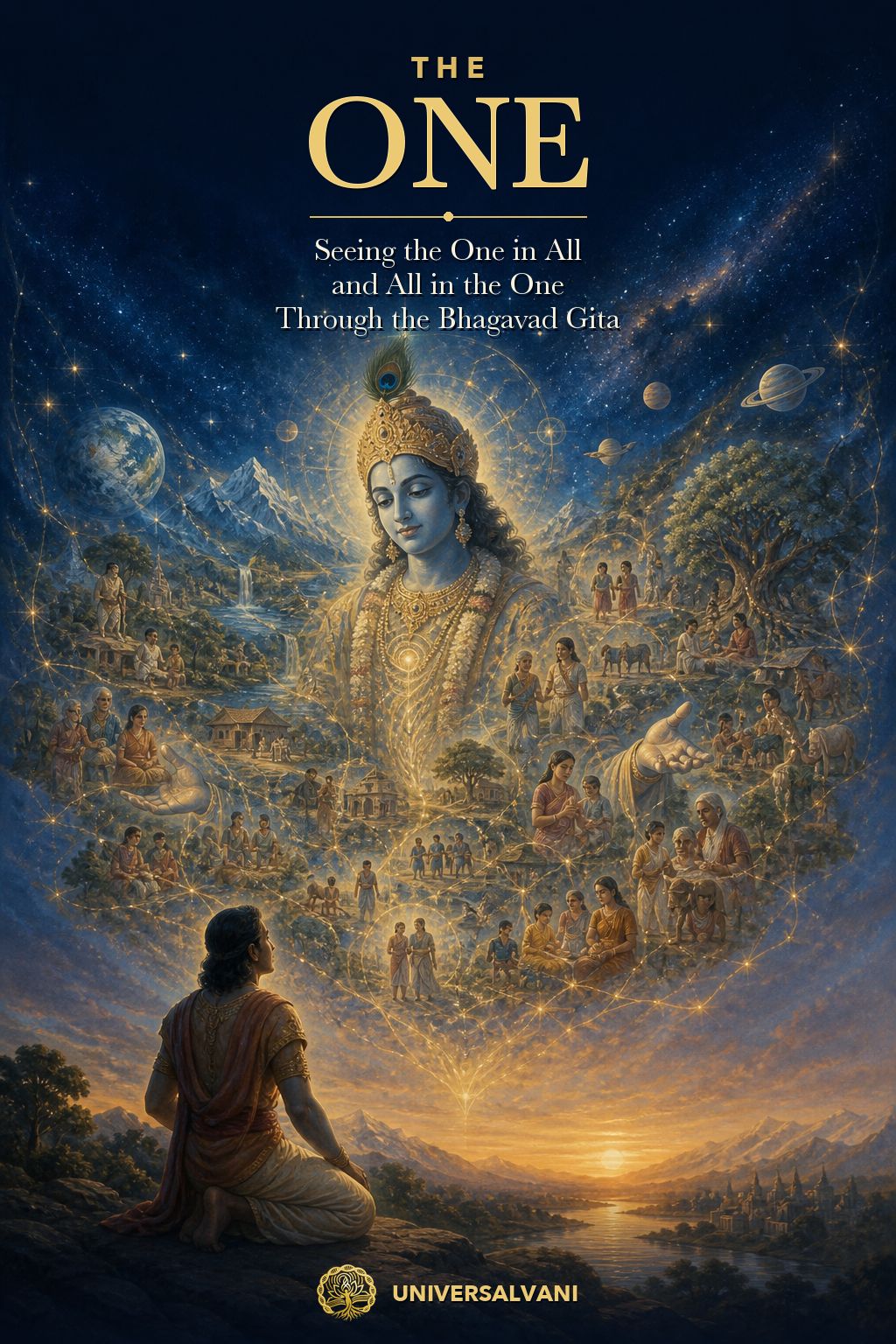
The book follows Asha Deshmukh, principal of a community school in Sahyadri Nagar, as exclusion, inherited land, public conflict and a threatened river test what “all is one” really demands.
Each chapter joins a lived dilemma to carefully cited Bhagavad Gita teachings, an independent plain-language rendering, a misunderstanding to avoid and a practical framework.
Get the eBook — ₹19917 Chapters
- The Meeting with Two Doors
- The Name Beneath the Uniform
- The Thread No One Could See
- The Empty Chair in the Office
- The Circle That Changed the Question
- The Measure of Another's Pain
- The River and the Sky Above It
- Different Needs, Equal Light
- The Student Who Refused the Photograph
- What Nilofer Asked Them to Hear
- The Land Their Father Left
- The Ledger with a Missing Column
- The Peace That Was Only Silence
- The Question Asha Could Not Avoid
- The Line Drawn Across the Map
- The Taste of Water
- The Gate Left Open in the Morning
Three teachings at the heart of the book
See the Self in all beings
Equal vision widens conscience. It does not erase difference; it refuses to make any life unreal.
Equal vision is not identical treatment
The wise see the same spiritual ground while still responding to different duties, needs and harms with discernment.
One reality, undivided in the divided
Unity becomes ethical only when it changes how we include, own, protect, oppose and care.

Everything you get for ₹199
- The full 124-page, 6×9 typeset PDF ebook
- 17 chapters following Asha and her community through one continuous inquiry
- 37 carefully cited Bhagavad Gita passages with original UniversalVani renderings
- 17 practical frameworks for applying equal vision in daily and public life
- A clear distinction between oneness and sameness
- Practical reflection on discrimination, property, borders, justice and Earth
- Instant download, plus an emailed backup copy
- 7-day guarantee, no questions asked
Your Honest Experience Matters
This edition is awaiting its first verified reader reviews. If you read it, we welcome your honest response—what became clearer, what remained difficult, and what could be improved.
Questions
See the many clearly. Do not lose sight of the One.
17 chapters. One continuous inquiry. A vision of unity tested in the places where life is hardest to share.